



Allergen Control 4.0: Efficient Testing, Objective Analysis, and Digital Traceability
25 May 2026Allergen control in the food industry is one of the pillars of modern food safety. Managing the risk of cross-contamination, verifying cleanliness, and proper documentation within the HACCP plan are more necessary today than ever before.
However, the real challenge lies not only in specific and sensitive detection, but also in conducting reliable testing and managing information in a structured manner.
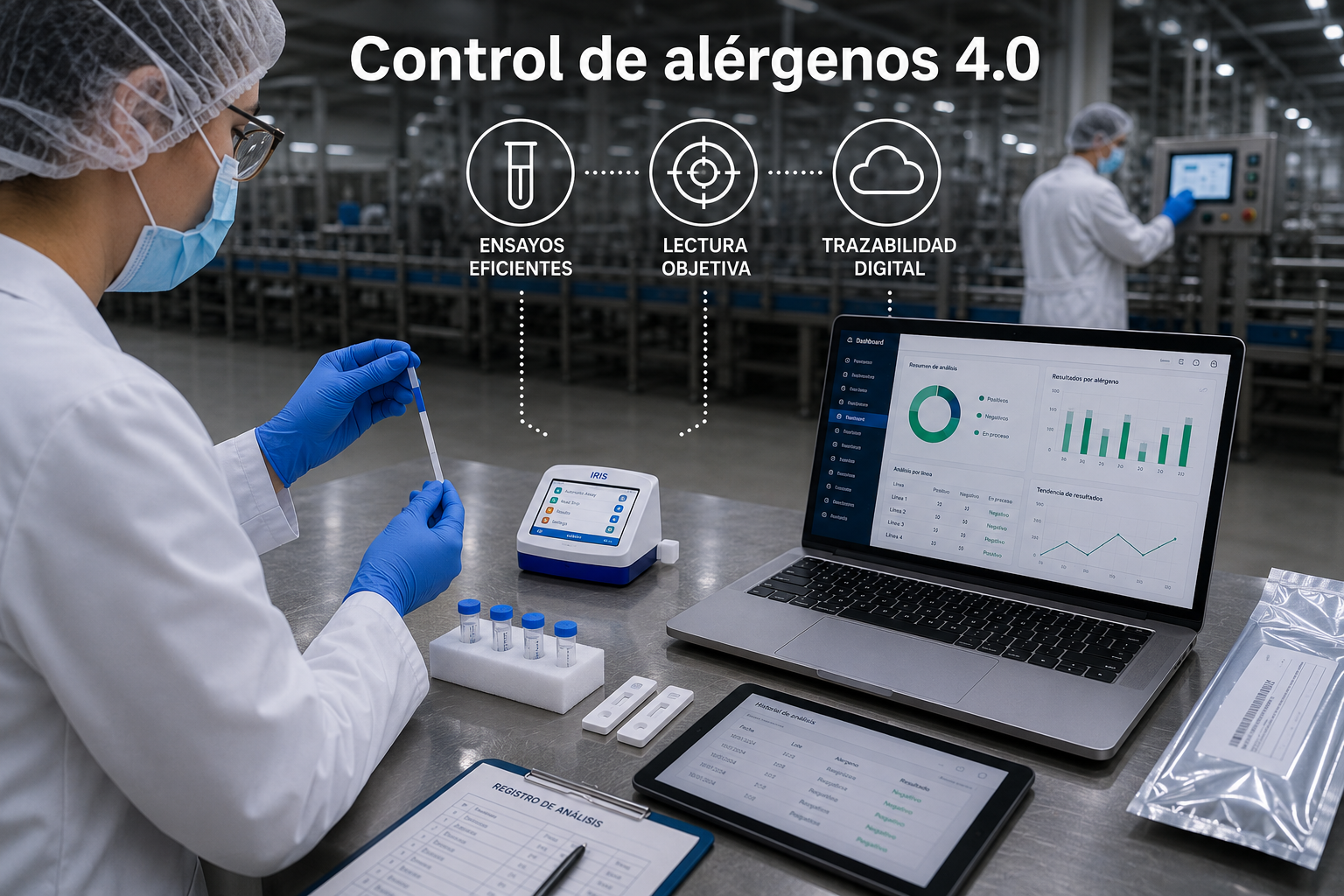
Welcome to Allergen Control 4.0: effective detection, objective result reading, and integrated digital traceability.
🔬 Effective detection: decisions in minutes with ready-to-use tests
The first step in effective allergen control is being able to immediately verify what is happening on the production plant. And this requires well-designed sampling.
Rapid tests are the best solution for verifying the effectiveness of cleaning processes, validating production changes, analyzing raw materials, and confirming the absence of cross-contamination in the final product.
This type of control brings agility to the quality department and allows decisions to be made at the right time, reducing risks and avoiding costs associated with recalls.
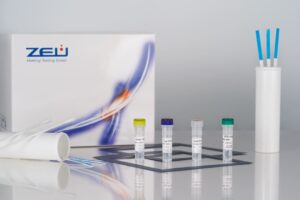
But speed alone does not make a process highly efficient. Allergen analysis also includes other elements. For example, having a kit with all reagents ready to use simplifies the testing steps; ensuring proper extraction of the allergen from the food using a specific protocol guarantees the reliability of the test; and having a portable system for on-site analysis reduces work time and the need to transport samples.
These considerations are the starting point for allergen control, but we must also take into account the value of,
🎯 Objective reading: eliminating uncertainty in the result
One of the biggest challenges in rapid tests is the visual interpretation of the result and its recording. Questions such as: Does the detection band indicate a very weak positive or is it negative? Does the interpretation vary depending on the operator evaluating the result? Could the information be questioned during an audit if I only have a handwritten record?
The incorporation of an objective optical reading system for the tests eliminates subjectivity and standardizes the results. This improves reproducibility, strengthens internal reliability and provides greater assurance for IFS, BRC, or ISO 22000 audits. When interpretation no longer depends on individual judgment and becomes automated, control gains consistency and errors are minimized.
A standardized interpretation criterion, with a validated cutoff point, consistently distinguishes positive results from negative ones regardless of the operator or the time of the test. The numerical values of these results serve as a key reference, both for interpreting the test and for comparing it with subsequent and future tests.
Objectivity brings us to the final element under consideration,
📊 Digital traceability: from the result to the structured supporting record
Digitization is the next natural step. Recording results digitally allows for:
- Identify the sample, lot, operator, date, test type, etc.
- Store results in a structured manner.
- Retrieve historical data immediately.
- Export data for analysis or audits.
- Share information among quality managers.
- Demonstrate best practices in our processes over time.
Digital traceability in allergen control not only facilitates regulatory compliance but also turns data into a management tool. Organizations need to have reliable, traceable, and accessible information at all times.
Digitizing results makes data available faster and enables real-time sharing. These processes can be streamlined by storing results in the cloud. This way, all managers can access the data or receive real-time updates via email.
In summary, a comprehensive allergen control system must include a combination of:
- Ready-to-use rapid tests for immediate decisions.
- An objective reading to eliminate interpretation errors.
- Digital management to ensure traceability.
This strategy transforms the traditional approach into a modern, connected system.
Allergen Control 4.0 is not just about testing, but about how you do it to integrate detection, interpretation, and documentation into a single workflow.
In an environment where food safety is critical and audits are becoming increasingly demanding, having a structured system makes all the difference.
Zeulab continues to provide simple and innovative solutions that help the industry ensure food quality and safety.
For more information, please contact us at marketing@zeulab.com.